Greek Wines: A Journey from Amyndeon to Crete and Santorini
Greek wine rarely announces itself in one familiar style. It changes with the landscape: cool upland vineyards in Western Macedonia, mountain-framed sites in Crete and low, basket-shaped vines rooted in Santorini’s volcanic soil. For travellers, that diversity is part of the pleasure. A glass can introduce a grape, but it can also explain a place.
This journey focuses on three revealing stops—Amyndeon, Crete and Santorini—and on producers whose stories illuminate them. Along the way, Xinomavro, Dafni, Plyto, Assyrtiko and Vinsanto show why Greek wines are best explored region by region rather than treated as a single category.
Greek wine overlooking Santorini’s volcanic landscape
Ancient roots and a modern wine identity
Wine has been part of Greek culture for millennia, although its history is richer than the familiar image of Dionysus holding a cup. In mythology, Dionysus was the god associated with wine and its transforming power. In daily life, however, wine was also social, agricultural and commercial. At the ancient symposium, water and wine were mixed in a large krater, and the strength of the drink was set by the symposiarch. The practice belonged to a particular social ritual; it should not be confused with the way Greek wine is served today.
Modern Greek wine draws strength from a different kind of continuity. Native grapes remain central, while careful viticulture and contemporary winemaking reveal how dramatically altitude, wind, soil and proximity to the sea can change a wine. Protected Designation of Origin (PDO) and Protected Geographical Indication (PGI) names can therefore help travellers read a label: they connect the wine to a defined place and production framework.
Amyndeon: Xinomavro in Greece’s cool north
Amyndeon—also written Amyntaio or Amynteo—lies in Florina, in Western Macedonia, far from the island landscapes many visitors first associate with Greece. Its vineyards occupy a high plateau in one of the country’s coolest wine regions. Winters can be cold and snowy, summers are relatively dry, and nearby lakes help moderate the continental climate. The PDO zone has an average elevation of about 615 metres, an important part of the freshness for which its wines are known.
The defining grape is Xinomavro. Under PDO Amyndeon, it is the sole permitted variety and produces dry red wine as well as rosé and sparkling rosé styles. Its naturally firm acidity and tannic structure can give red wines the capacity to develop with age; meanwhile, rosé and sparkling expressions reveal a lighter, more immediate side of the same grape. The wider PGI Florina designation is broader. It allows other native and international varieties, including Malagousia, Chardonnay and Sauvignon Blanc. Keeping those two designations distinct avoids a common source of confusion.
Kir-Yianni and the modern story of Amyndeon
Kir-Yianni is one important name in this modern story, alongside other producers across the plateau, founded in 1997 Kir-Yianni.
For a traveller, Amyndeon offers a useful lesson in Greek wine. Northern Greece is not a warm-climate footnote to the islands. Here, elevation, inland weather and water create a markedly different setting, and Xinomavro can move from structured red wine to finely drawn rosé and sparkling styles.
Crete: an island of rediscovered grapes
Crete’s size and topography make simple descriptions difficult. Mountain ranges, plateaus, valleys and exposure to the sea create many local growing conditions. Although summer heat matters, altitude and maritime influence can moderate it. The island’s vineyards support a broad group of native grapes, including the white varieties Vidiano, Vilana, Dafni and Plyto, and the red varieties Liatiko, Kotsifali and Mandilaria. Together, they give Cretan wine an identity that cannot be reduced to one flagship grape.
Lyrarakis in Alagni, Heraklion
The family-owned Lyrarakis winery was established in 1966 by the brothers Manolis and Sotiris Lyrarakis. It is based in Alagni, in the Heraklion region, and is now run by the second generation. Its most important contribution is its work with rare Cretan grapes. Dafni and Plyto were planted in the family’s Psarades vineyard in 1992, while Melissaki followed in another vineyard in 2010. That work helped return varieties with very limited plantings to serious attention.
Lyrarakis also produces verjuice, known in Greek as agourida. This is tart juice pressed from unripe grapes and used as a gentle acidifying ingredient in food, and cocktails. It is not an ingredient added to wine during winemaking. More interestingly, verjuice belongs to the culinary uses of the vine beyond the bottle.
A Cretan tasting becomes especially rewarding when it includes grapes that may be unfamiliar. Rather than asking only for “a local white” or “a local red,” ask which indigenous variety is in the glass and where it was grown. The answer often opens a wider conversation about altitude, soil, farming and the revival of the island’s wine heritage.
Santorini: volcanic soil, wind and the kouloura
Santorini has one of the Mediterranean’s most recognisable wine landscapes. Its vineyards grow in porous volcanic soils under intense sun, very low rainfall and strong Aegean winds. To protect grapes from wind and exposure, growers traditionally train vine canes into a low basket known as the kouloura. The technique is not picturesque decoration; it is a practical response to a demanding environment.
Assyrtiko is the island’s best-known grape. It produces dry wines noted for freshness, structure and a distinctly saline impression. Athiri and Aidani also contribute to Santorini’s white wines, while Mavrotragano is among its red grapes. Vinsanto offers another expression of the island: a naturally sweet PDO wine made from sun-dried grapes, principally Assyrtiko, often with Aidani. Thus, Santorini’s wine story extends well beyond a single dry white style.
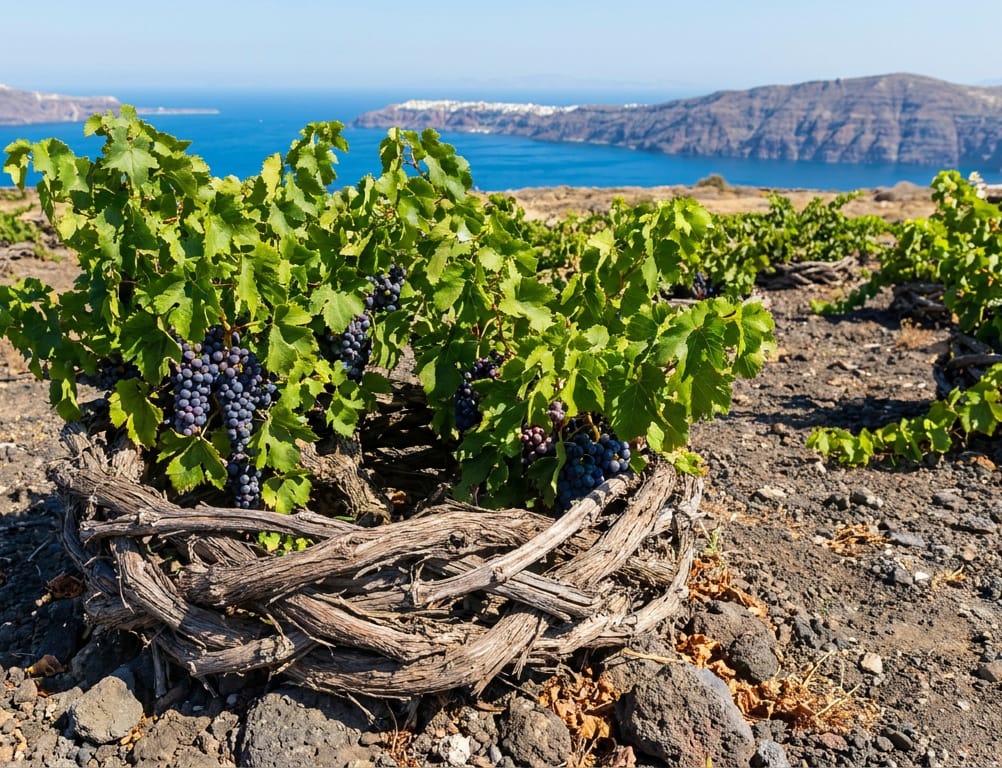
The “kouloura”
Pyrgos, Santo Wines and Hatzidakis Winery
Pyrgos is one of Santorini’s highest villages, built on a hill below Profitis Ilias. Its lanes rise towards the remains of the Kasteli, one of the island’s fortified settlements, while the upper village opens broad views across Santorini. The setting brings the island’s architecture, defensive history and vineyards unusually close together. Hatzidakis Winery , Santo Winer
How to explore Greek wines while travelling
A useful starting point is to choose by place and grape, not only by colour. In Amyndeon, compare Xinomavro as red, rosé or sparkling wine. In Crete, seek out a native variety such as Vidiano, Dafni, Plyto or Liatiko. On Santorini, compare a dry Assyrtiko with Vinsanto to see how one landscape can produce radically different expressions.
Food provides another route into the subject. Assyrtiko’s freshness often works well with seafood and salty island flavours. Xinomavro can suit lamb, veal and tomato-based dishes, while Cretan whites can be explored alongside vegetables, herbs and local cheeses. These are starting points rather than rules; the producer, vintage and style still matter.
Finally, check current visiting arrangements directly with each winery and reserve ahead when necessary, especially in busy travel periods. A thoughtful tasting is not simply a sequence of glasses. At its best, it reveals how climate, landscape, grape variety and human decisions meet—and why Greek wine tastes less like one national style than a map of many different places.
Wine is meant to be shared, remembered, and enjoyed in moderation. Drink beautifully and responsibly.
you might be interested to
see What to do during your Greece Vacation or check our A Taste of Greece, culinary tour.