
Suggested Itinerary for this educational private tour. Only members of the group you’ll form will participate.
Greece Marine Biology Study Abroad

Home > Educational Tours > Greece Marine Biology Study Abroad
Greece Marine Biology Study Abroad
Explore the connection between the sea, its ecosystems and the civilizations that grew along Greece’s shores on this 20-day marine biology study abroad program.
Beginning in Athens, you encounter sea turtle conservation and the maritime world of ancient Greece before continuing to the Peloponnese, Pavlopetri and the seagrass habitats of Elafonisos.
Then, in Crete, marine science, Minoan archaeology and historic harbours reveal further links between people and the Mediterranean. Along the way, observation, discussion and student projects bring biodiversity, climate change and coastal management into focus.
The journey connects academic study with places you can examine directly, from working harbours and protected shores to submerged archaeology.
Itinerary
Short-term Field Study Abroad Program in Marine Biology, Climate Change & Maritime Civilizations of Greece
Greece provides direct access to the Mediterranean Sea — a globally recognized biodiversity hotspot that covers less than 1% of the world’s ocean surface yet hosts roughly 7–10% of known marine species, including many endemic species.
A short-term program in Greece may include seasonally adapted activities such as:
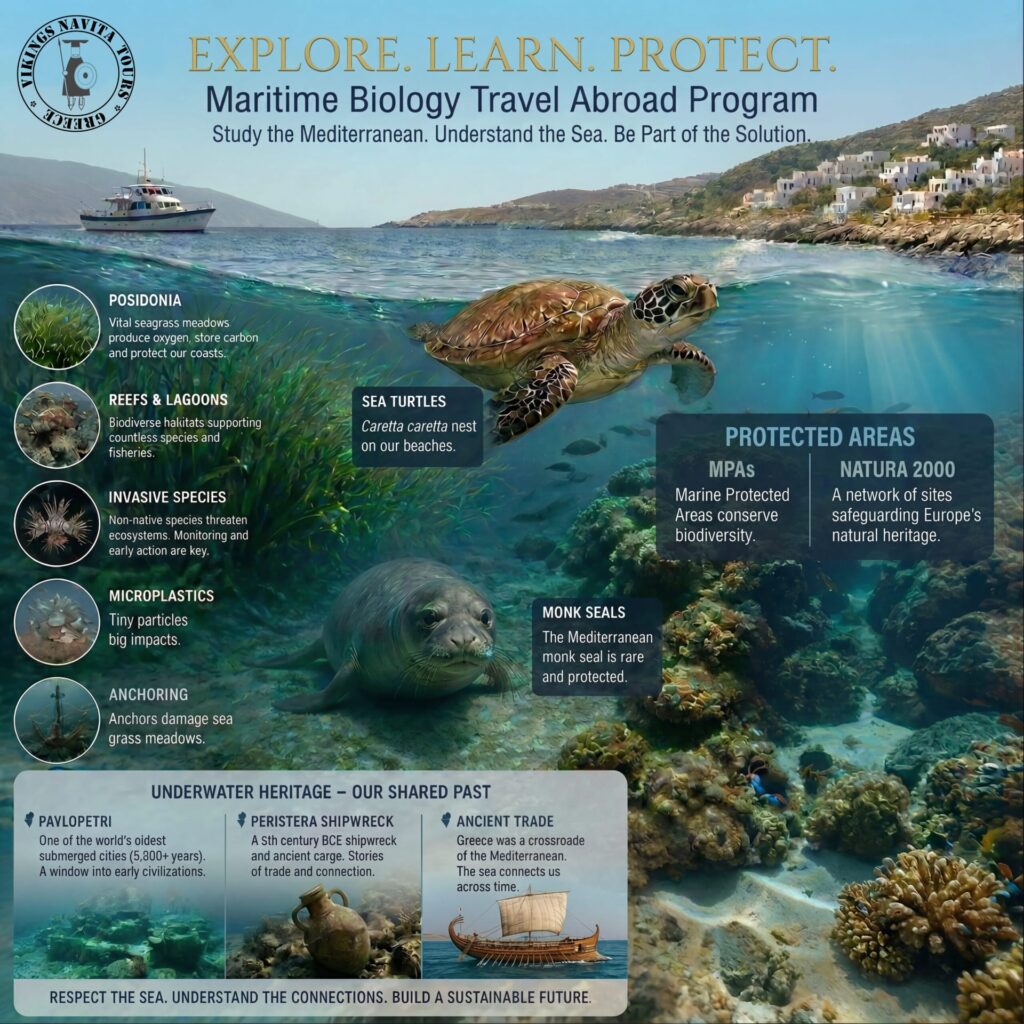
• Study of Posidonia oceanica meadows — the endemic Mediterranean seagrass species critical for biodiversity support, shoreline stability, and blue carbon storage — including examination of anchoring pressures and climate-related stressors.
• Conservation briefing, habitat interpretation and responsible observation where possible of protected marine species like Caretta caretta (Mediterranean loggerhead turtle populations) and Monachus monachus (Mediterranean monk seal), one of the world’s most endangered marine mammals, with key habitats in the Aegean region.
• Visit to ARCHELON – The Sea Turtle Protection Society of Greece (Athens) to observe rehabilitation and conservation practices.
• Marine archaeology component at Pavlopetri (southeastern Peloponnese), one of the oldest known submerged settlements (Bronze Age), offering interdisciplinary perspective on sea-level change and coastal geomorphology.
• Engagement with institutions such as the Hellenic Centre for Marine Research (HCMR) and Greek universities for thematic sessions, field exposure, or research-related interaction. Subject to availability and formal approval.
• Optional cultural and archaeological components — including site visits and hands-on workshops (e.g., traditional crafts, culinary practice, or music/dance) — may be incorporated to contextualize contemporary marine and coastal systems within Greece’s long historical continuum.
• Greece presents a compact and accessible natural laboratory for examining the Mediterranean as a semi-enclosed, climate-sensitive marine basin where biodiversity, human maritime activity, and environmental change converge.
The program may integrate climate change and oceanography in the Mediterranean – a semi-enclosed basin warming faster than global averages – together with Marine Protected Areas within the Natura 2000 network, including the National Marine Park of Alonissos, fisheries management dynamics, marine spatial planning, and the broader EU marine policy framework.
Depending on faculty priorities, seasonal timing and availability, activities may include guided field exposure, site-based observation, interaction with local research initiatives, and thematic seminars.
Greece offers an ideal destination for field-based learning, where students can examine how biodiversity, conservation practice, policy, and human maritime activity interact within a climate-sensitive marine environment.
The structure is intentionally flexible and can be further discussed and adapted according to academic priorities and logistical parameters.
Given Greece’s 8,500 miles of coastline and 6,000 islands and islets, its direct access to the Mediterranean basin, concentration of biodiversity, conservation initiatives, and marine policy frameworks, we believe it may offer a suitable setting for a faculty-led program aligned with your study abroad portfolio.
Indicative Itinerary
Day 1 Arrival in Athens and Welcome Dinner
On arrival at Athens International Airport, meet your licensed guide and transfer by private coach to your hotel. Depending on your arrival time, settle in or take a first walk through the historic centre before the program begins.
In the evening, gather for your welcome dinner. Professors will introduce the course themes, setting the scene for a journey that connects marine science with the history and everyday life of coastal Greece.
Overnight in Athens. (D)
Day 2 Athens and the Maritime World of Ancient Greece
After breakfast, visit the Acropolis and the Acropolis Museum with your licensed guide. Discover how maritime trade, naval power and connections across the Aegean helped shape classical Athens.
Later, a faculty-led seminar introduces the Mediterranean as a semi-enclosed sea. Explore how its circulation and biodiversity relate to the ports and societies along its shores. You will also choose a question to follow throughout the journey, from coastal habitat protection to the links between seaborne exchange and settlement.
Overnight in Athens. (B)
Day 3 ARCHELON and the Athens Riviera
Visit ARCHELON’s Sea Turtle Rescue Centre in Glyfada for a prearranged educational tour. Learn how injured turtles are rescued and rehabilitated, and how fishing interactions, vessel strikes and marine pollution affect their conservation.
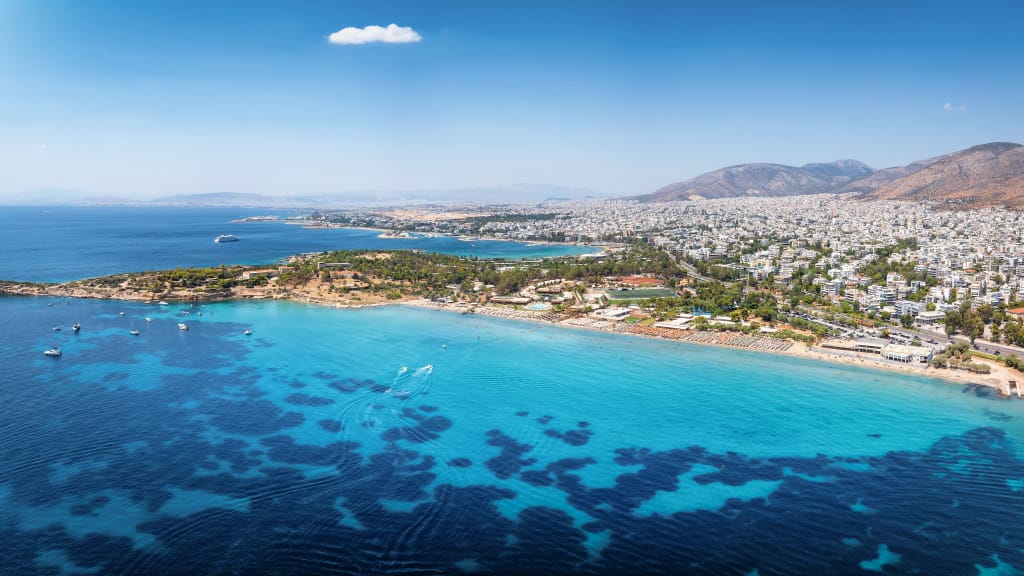
After lunch, continue to an accessible stretch of the Athens Riviera for your first coastal observations. Practice recording habitat types, visible human pressures and beach litter. Where present, detached Posidonia leaves offer an introduction to seagrass meadows and their ecological importance.
Overnight in Athens. (B, L)
Day 4 Marine Research at Anavyssos and Cape Sounion
Travel along the Attica coast to Anavyssos for a proposed thematic session with the Hellenic Centre for Marine Research. Topics may include Mediterranean circulation, marine heatwaves, ocean monitoring and how scientists investigate environmental change.
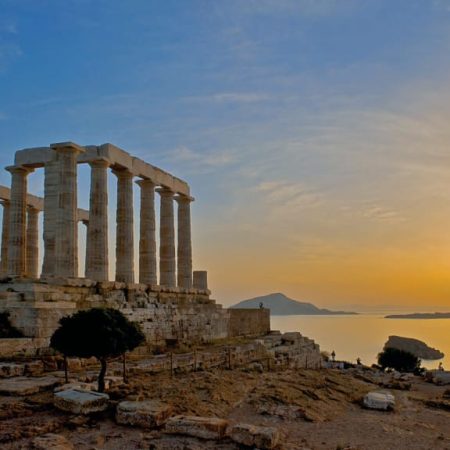
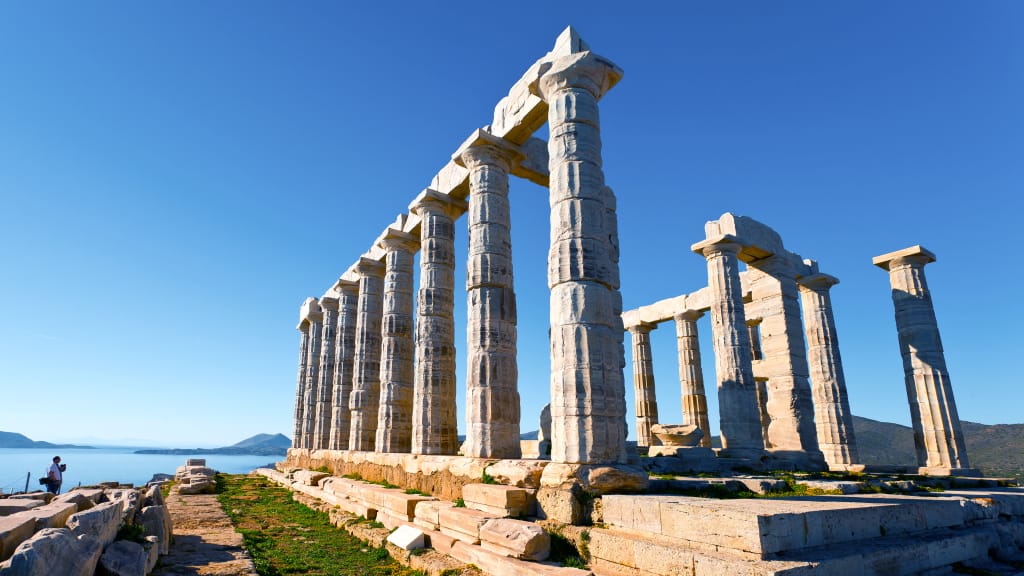
Afterward, continue to Cape Sounion and the Temple of Poseidon. Looking across the Aegean, connect the morning’s scientific perspective with ancient navigation, coastal landmarks and the place of the sea in Greek religious life.
Overnight in Athens. (B)
Day 5 Corinth Canal and Ancient Corinth to Nafplio
Leave Athens by private coach and stop at the Corinth Canal to explore maritime routes and the engineering of connections between seas.
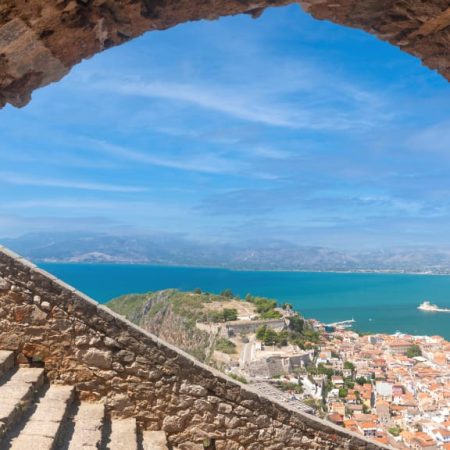
Then continue to Ancient Corinth, where your guide explains how the city’s position between the Corinthian and Saronic gulfs helped shape its commercial importance. In the afternoon, travel to Nafplio, your base on the Argolic Gulf. After check-in, walk along the waterfront and consider how the historic port is used today.
Overnight in Nafplio. (B)
Day 6 Argolic Gulf Coastal Habitats and Fisheries
Spend the morning at selected accessible coastal sites near Nafplio and Tolo.
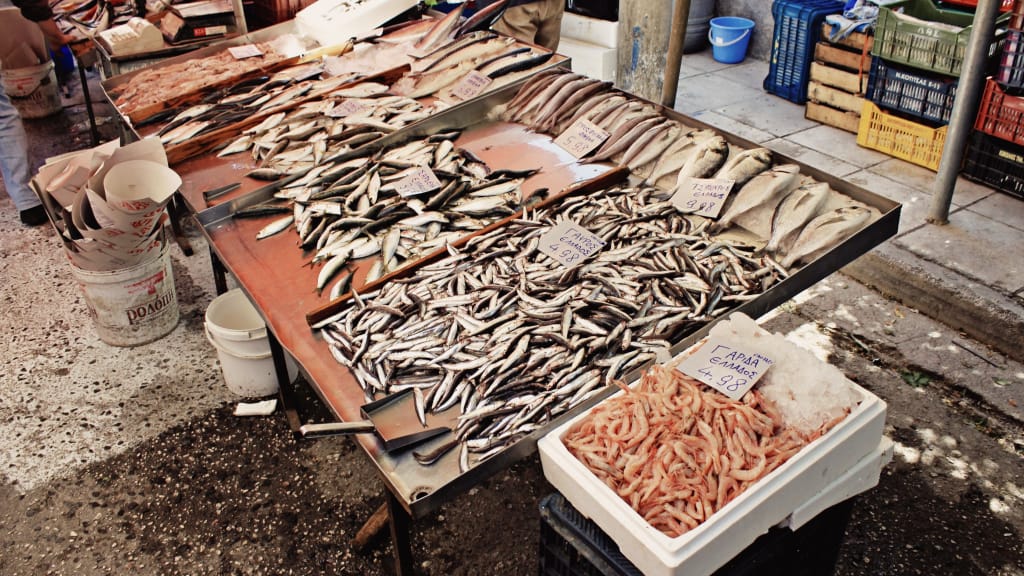
At a local harbour, discuss small-scale fisheries, seasonality and seafood supply. A conversation with a fisher or local specialist can be requested in advance. After lunch, return to Nafplio for a short workshop on field notes, the limits of visual observation and scientific approaches to assessing seagrass condition.
Overnight in Nafplio. (B, L)
Day 7 Monemvasia and the Coast of Laconia
Travel south through the Peloponnese to Monemvasia. On a guided walk through the fortified town, explore how its coastal setting influenced defence, trade and contact across the Mediterranean.
After time for lunch independently, continue to Neapoli Voion, your base for Pavlopetri and Elafonisos. Today combines travel with maritime heritage. Once settled, use published maps to become familiar with the coastal landscape you will study over the next two days.
Overnight in Neapoli Voion. (B)
Day 8 Pavlopetri and Changing Coastlines
Travel to the Pounta coast opposite Elafonisos to study Pavlopetri, a submerged settlement occupied from the Late Neolithic through the Bronze Age. Begin on shore, using published plans and research to explore its layout and coastal setting.
Next, examine how archaeologists and marine scientists reconstruct earlier coastlines. Consider sea-level change, tectonic movement, subsidence and coastal processes as possible explanations for the site’s submergence. After lunch, compare the ancient landscape with today’s coast.
Overnight in Neapoli Voion. (B, L)
Day 9 Elafonisos and Posidonia Habitats
Take the short local ferry from Pounta to Elafonisos for a day exploring seagrass habitats, beaches and coastal management. The Neapoli and Elafonisos Natura 2000 area [4] includes Posidonia communities, giving your studies a direct connection with the surrounding landscape.
At suitable accessible sites, examine beach wrack, dune vegetation and the relationship between visitor activity and habitat protection. Repeat selected shoreline observations, then use published habitat maps to discuss seagrass distribution, anchoring pressure and blue carbon. Supervised snorkelling may be added where permitted and suitable, while the core day remains accessible through shore-based observation.
Overnight in Neapoli Voion. (B)
Day 10 Return to Athens and Review of the Peloponnese
Return to Athens by private coach, with rest stops along the route. An overnight in the capital separates today’s road journey from your flight to Crete.
After check-in, organize your field notes and prepare a short comparison of the Argolic Gulf and the Neapoli coast. The evening is free for an independent meal and rest before the next stage of your journey.
Overnight in Athens. (B)
Day 11 Athens to Heraklion and the Cretan Coast
Transfer to Athens Airport for your flight to Heraklion. On arrival, meet your Cretan coach and transfer to your hotel.
Later, take an introductory walk through the historic centre and along the harbourfront. Your guide introduces the city’s maritime setting, while professors outline the next stage of the course: marine biodiversity, fisheries and coastal change in the southern Aegean.
Overnight in Heraklion. (B)
Day 12 CRETAquarium and Marine Science at Gournes
Visit CRETAquarium at Gournes, part of the Hellenic Centre for Marine Research. Explore its Mediterranean displays through species identification, ecological relationships and the ways marine science is shared with the public.
After lunch, a proposed specialist session at HCMR explores a theme such as marine biodiversity, aquaculture or climate-related change.
Overnight in Heraklion. (B, L)
Day 13 Knossos and the Maritime Connections of Minoan Crete
Visit Knossos and the Heraklion Archaeological Museum with your licensed guide. Examine how material evidence, marine imagery and imported objects help researchers interpret Minoan exchange and contact across the eastern Mediterranean.
In the afternoon, a seminar connects this evidence with the natural resources and coastal environments explored during the first half of your journey. Discuss what archaeological objects reveal about maritime connections, as well as the questions that remain open. Later, enjoy time in Heraklion independently.
Overnight in Heraklion. (B)
Day 14 Mirabello Bay and Contemporary Maritime Livelihoods
Travel east towards Agios Nikolaos and Mirabello Bay. A short educational boat excursion is proposed, offering a view of the coastline from the sea.
Explore how fishing, tourism and aquaculture share coastal space. Local observations and published research will introduce non-native species and changing ecological conditions in the eastern Mediterranean. A meeting with a fisher or sector specialist can be requested.
Overnight in Heraklion. (B)
Day 15 Rethymno Turtle Habitats and Onward to Chania
Leave Heraklion and stop near Rethymno, where loggerhead turtles nest along a coast also used extensively for tourism. Study how lighting, beach furniture, access and development affect habitat management.
After lunch and a short walk through the historic harbour area, continue to Chania. Check in at your hotel and enjoy your first evening in western Crete.
Overnight in Chania. (B, L)
Day 16 Chania Maritime Heritage and Traditional Shipbuilding
Explore the Maritime Museum of Crete and Chania’s Venetian harbour with your guide. Connect ship models, navigation and naval history with the maritime societies you encountered in Athens and the Peloponnese.
Where the seasonal schedule permits, continue to the museum’s separate exhibition of ancient and traditional shipbuilding at Neorio Moro. The afternoon is available for student work on harbour design, trade and coastal urban change.
Overnight in Chania. (B)
Day 17 Elafonisi and Protected Coastal Landscapes
Travel to Elafonisi in southwestern Crete for a full day exploring a protected coastal landscape. Distinct from Elafonisos in the Peloponnese, this island and the adjacent Cretan coast form a Natura 2000 site.
Follow designated access routes to observe shallow marine habitats, sandy shores, dune vegetation and visitor pressure. Lunch and return to Chania.
Overnight in Chania. (B, L)
Day 18 Chania and cultural workshop
A cultural workshop, such as pottery or preparing traditional Cretan sweets, can be arranged as an optional addition. Afternoon at leisure.
Overnight in Chania. (B)
Day 19 Return to Athens and Farewell Dinner
Transfer to Chania Airport for your flight to Athens, then continue by private coach to your hotel.
In the afternoon, present your findings and compare the coastal settings explored throughout the program. Topics may include seagrass conservation, turtle habitat management or the relationship between maritime heritage and modern coastal use. Finally, gather for your farewell dinner.
Overnight in Athens. (B, D)
Day 20 Departure from Athens
After breakfast, transfer by private coach to Athens International Airport for your departure flight, bringing your 20-day program to a close.
End of services. (B)
Departures
Dates 2027:
Dates are flexible and can be arranged around your institution’s calendar, subject to availability.
Included
- Accommodation in 3 star hotel in Athens in shared twin/triple rooms.
- Accommodation in 3 star hotel in Nafplio in shared twin/triple rooms.
- Accommodation in 3 star hotel in Crete in shared twin/triple rooms.
- Air tickets Athens to Crete and v.v.
- Breakfast (19).
- Meals 8 (Lunches or dinners, included welcome and farewell dinners).
- Welcome dinner( 1)
- Farewell dinner ( 1)
- Transfers Athens Airport to your hotel and v.v.
- Transfer in Heraklion port to hotel and v.v.
- English speaking guide
- Private coach transportation in the Athens, the Peloponesse and Crete.
- Assistance 7/24 by our reps. in Athens
Not included
- Climate resilience tax.
- Air flights (except where specifically stated as included).
- Porterage, Tips.
- Optional activities and excursions.
- Admissions fees to the sites and museum (except where specifically stated as included).
- Any services not specifically mentioned as included.
Price
- Upon request depending mainly on number of participants and period of the year.
Remarks
- This is a private tour and is intended for groups only. Only the group you formed will participate.
- Requires a minimum of participants
- Itineraries can be changed at the discretion of the company in case of adverse weather conditions or in case of other extraordinary conditions.
Pre & Post Tour
We’re here to ensure your travel experience is seamless from start to finish. Beyond your tour, we gladly assist with arranging pre- and post-tour services including hotel reservations, guided excursions, dining options, transportation, and more.
Vikings Navita is ready to personalize your itinerary, providing comfort, convenience, and unforgettable experiences every step of the way.


click image to see more…
Frequently Asked Questions About Spring Break Study Tour to Greece
Who is this study tour designed for?
The program is designed for organized educational groups, including colleges, universities and faculty-led student groups. Only members of your own group participate, allowing the journey to follow the academic interests, pace and character of your institution.
Can the dates fit our institution’s spring-break calendar?
Yes. Dates are flexible and can be arranged around your institution’s spring-break period, subject to availability. The same itinerary may also be organized as a cultural study tour at another time of year.
Can the program be adapted to our group’s academic interests?
Yes. This is a private educational program, and we encourage faculty members to tell us about their students, academic interests and particular areas they would like to emphasize. These details can be considered when preparing the final proposal and itinerary.
Is there free time for students?
Yes. Although the journey has a strong educational program, students also have time to experience Greece independently. The current itinerary includes free time in Athens and Heraklion, giving participants a chance to explore, relax or simply enjoy being somewhere new.
Contact Us
Other Cruises & Tours in Greece you might be interested in
Cruise the Cyclades onboard a yacht after you’ve admired the Acropolis of Athens and it’s surroundings. You’re thinking of visiting the capital city of Greece, Athens and ad an island? Then the Enjoyable Athens and Mykonos Island is just for you!